See your remodel before we build it
What the company builds, how the three steps work and how to ask for a call, with the offer repeated at the top and the bottom.
firstlookbuilders.comOpen full page
Ori Nozar Los Angeles and New York
I'm a two-time graduate of the University of Wisconsin-Madison, with a BBA in Real Estate and Urban Land Economics and an MS in Business Analytics. I've worked in capital markets at Colliers, on business acquisitions at Joon Development Group, and in private-fund data operations at Chronograph. I also build the software I use to source, underwrite and run deals. You can see my prior work and projects below.
The real versions of these tools run on confidential deal rooms, a live CRM and real client projects. The screens on this page are working copies: every company and person carries an invented name such as Example Company XYZ, and the figures are illustrative. There are three exceptions: the CRM and target-list totals, which are real counts with every name left out; the design package and 3D model, which are real designs with the client's name removed; and the web design pictures, which are the examples published on the First Look Builders site.
A CRM I built for an acquisition firm that buys companies directly from their founders. It finds the owner's direct line, writes the first email, sends in safe batches and tracks every reply. The totals on the screen are real.
Import a list, and AI agents research each named owner's direct email and phone number. Nothing is written until a proposed change is reviewed and applied, with per-run revert. Sends go out through the firm's own mailbox inside a window and a daily cap; bounces refund the cap, dead-end the company and are swept into folders. Replies land in a workbench with respond-by deadlines. Follow-ups are scheduled by rule: a short note after 90 days of silence, and a nudge when a live conversation goes quiet.
Everything lives in MongoDB Atlas. Each company is one document holding its 50 imported fields, contact research, fit score and pipeline stage. Fields edited by hand are locked so a later import cannot overwrite them. Every send, reply and bounce is appended to an activity log, and the outreach numbers above are counted from that log (phone calls are logged by hand). Research and drafting jobs are queued as documents too, and a result is saved only after it is reviewed. The Data model tab shows the collections and a sample record.
This is how companies get found and added to the CRM. Each list covers every independent company in one industry across seven Southern California counties, scored for acquisition fit and pushed into the CRM from one dashboard.
A research pipeline builds each list from state license records, company sites and trade directories, flags chains and roll-ups as not a target, and scores the rest out of 100 on fit, size, succession, independence, strategy and reach. The table and the map are linked, every row carries its "why", and the filtered set pushes straight into the CRM queue.
A quality-of-earnings review for a small-business acquisition, on one screen. Figures link to the document they came from, and the real tool will not build a report if a number cannot be traced.
Try it. This is how I underwrite a small business. The screen compares four sets of documents for one company: tax returns, bank statements, the seller's books and the broker's memo. Click a figure to open the page it was read from, with the number highlighted. Calculated figures show their formula and each input.
On the Add-backs tab, accept or reject each adjustment the broker is claiming. SDE, the price multiple and the loan coverage recalculate on every tab.
Seller books, tax returns, bank statements and a broker memo rarely agree. The workbench rebuilds SDE (seller's discretionary earnings) line by line from the tax return, accepts some of the broker's add-backs (the owners' pay, the owners' share of a pension plan) and leaves others out (rent paid to the owners' LLC, depreciation, interest), reconciles revenue across the books, the return and the bank, follows sales through to cash, and tests whether an SBA loan at the asking price can be repaid.
Example Company XYZ is not a real company and its figures are illustrative. The method is the one I use on real deals.
A finder for residential land and redevelopment plays in Los Angeles: assessor parcels underwritten for their best use, with the owner outreach to go with them.
A pure-function engine runs every parcel through seven possible uses (spec build, lot split, ADU hold, add units, renovate and resell, lot rebuild, pass) with full land math: build cost, carry, selling costs, exit value from nearby comps, and the maximum offer that still pencils. Motivation signals such as long tenure, absentee ownership or an expired permit raise the score; hillside, fire and coastal flags lower it. A feasibility tab turns the winner into a budget, a phase timeline and return metrics.
One app that runs a residential remodeling contractor: sales, subcontractors, a knowledge base, design renders, contracts and overhead.
Leads book a 15-minute check-in, move to a walkthrough and then a design presentation. Subcontractors are vetted by AI in batches against the state license board, reviews and red flags. A Knowledge Q&A answers pricing and permit questions with citations and asks before it saves what it learned. The design studio turns a room photo into photoreal renders in 24 real architectural styles, keeps appliances where they are, fixes visible wear and damage and draws plan sheets to drafting conventions. Contracts go out as e-signature documents that follow Contractors State License Board (CSLB) rules.
A room is recorded once: its outline, openings, cabinets and appliances, each tied to what was seen in the walkthrough video. From that one record the app generates a floor plan, wall elevations, a cabinet cutaway, an interactive 3D model, two finish renders from the original camera position and a linked material schedule. Because all six come from the same numbers, they cannot disagree.
Three rules keep it honest. A generated render is never used as a measurement. Between renders only the finishes change; camera, layout and appliances stay put. Roof lines and openings are frozen before design starts.
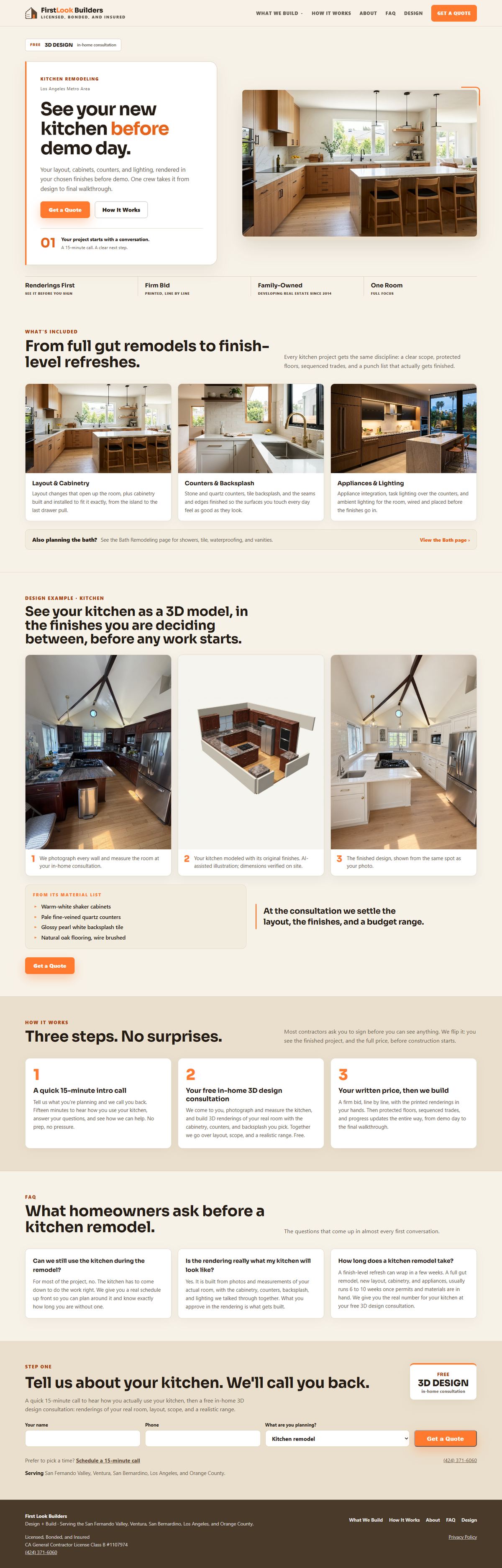
The Design package tab opens a real whole-house package: finished views and architectural sheets, room by room. The 3D model tab puts a photo of a real kitchen next to the 3D model built to match it.
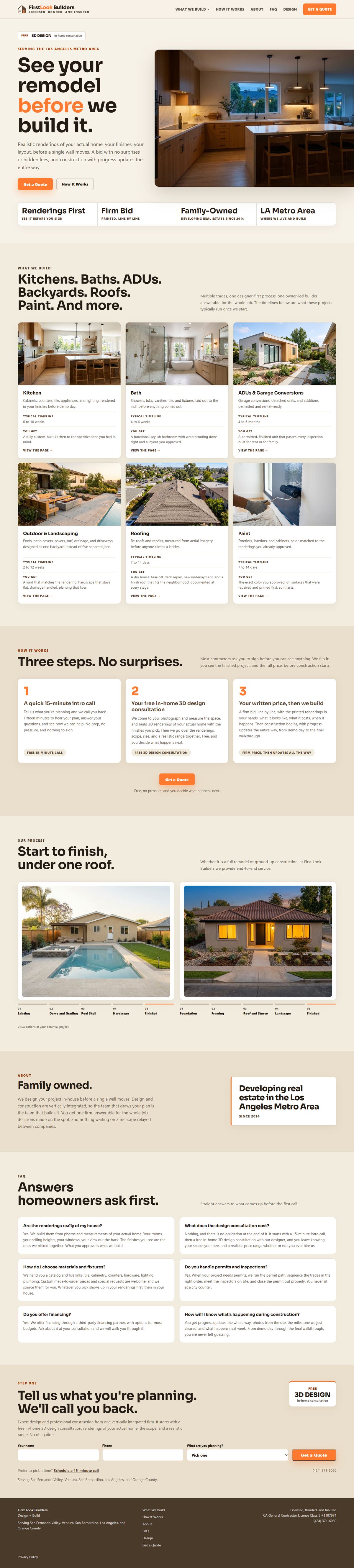
I designed and built firstlookbuilders.com for First Look Builders, a Los Angeles design-build contractor. Pick a page below. Each one scrolls from top to bottom on its own, and you can scroll it yourself or open the full page.
What the company builds, how the three steps work and how to ask for a call, with the offer repeated at the top and the bottom.
Layout, cabinets, counters and lighting shown in the chosen finishes, with a real kitchen taken from photo to 3D model to finished design.
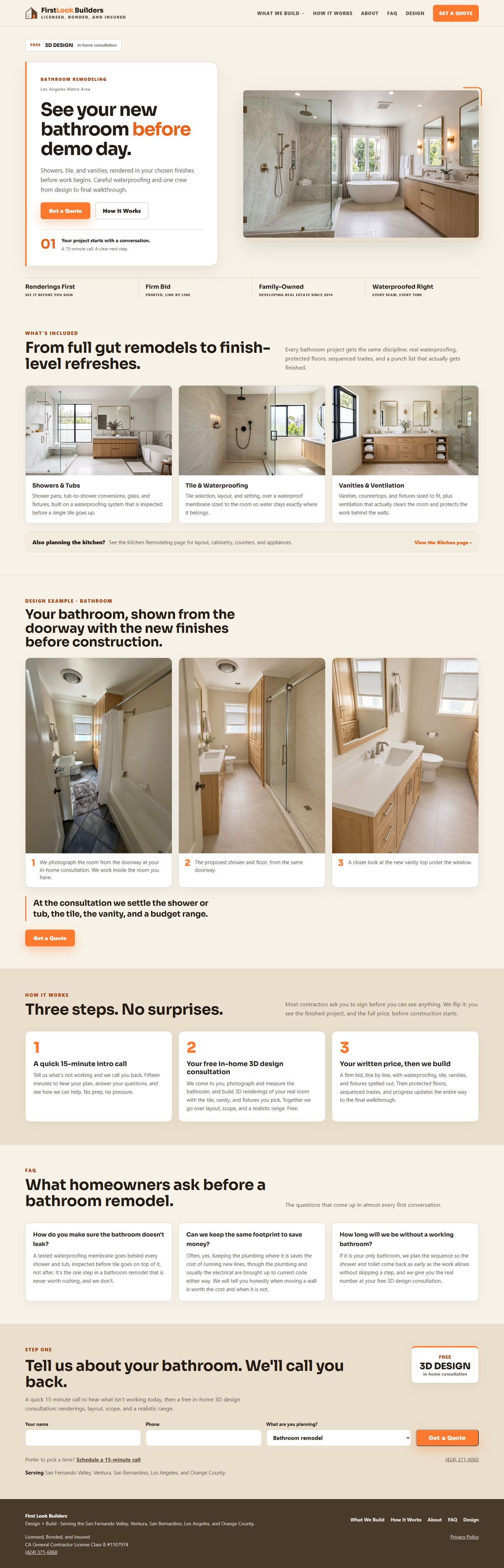
Showers, tile and vanities shown in the chosen finishes before work begins.
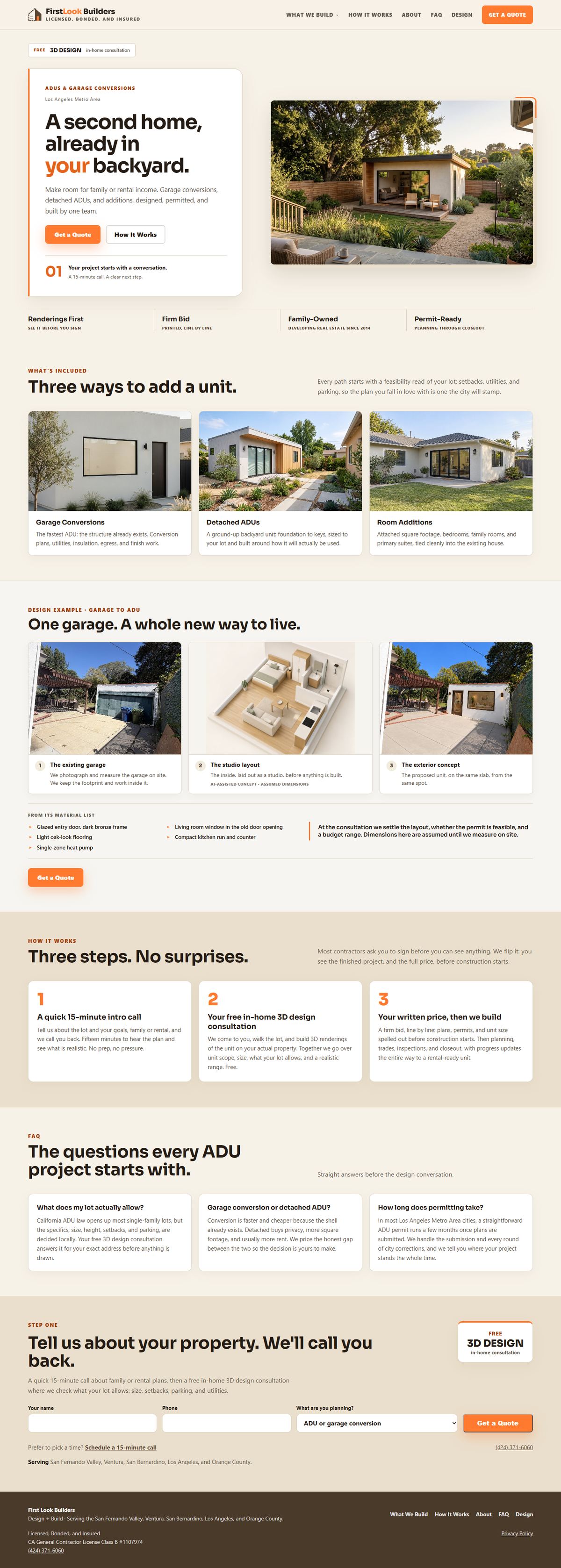
Garage conversions, detached units and additions, with one garage shown as the home it could become.
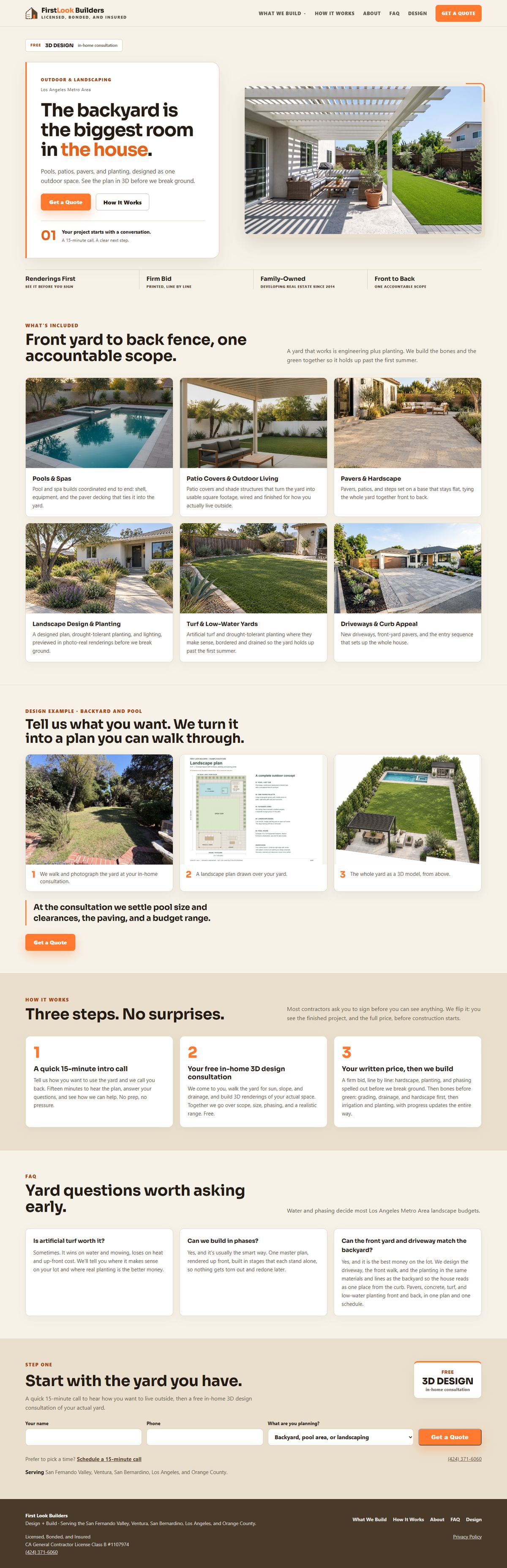
Pools, patios, pavers and planting designed as one space, from a photo of the yard to a plan to a 3D model.
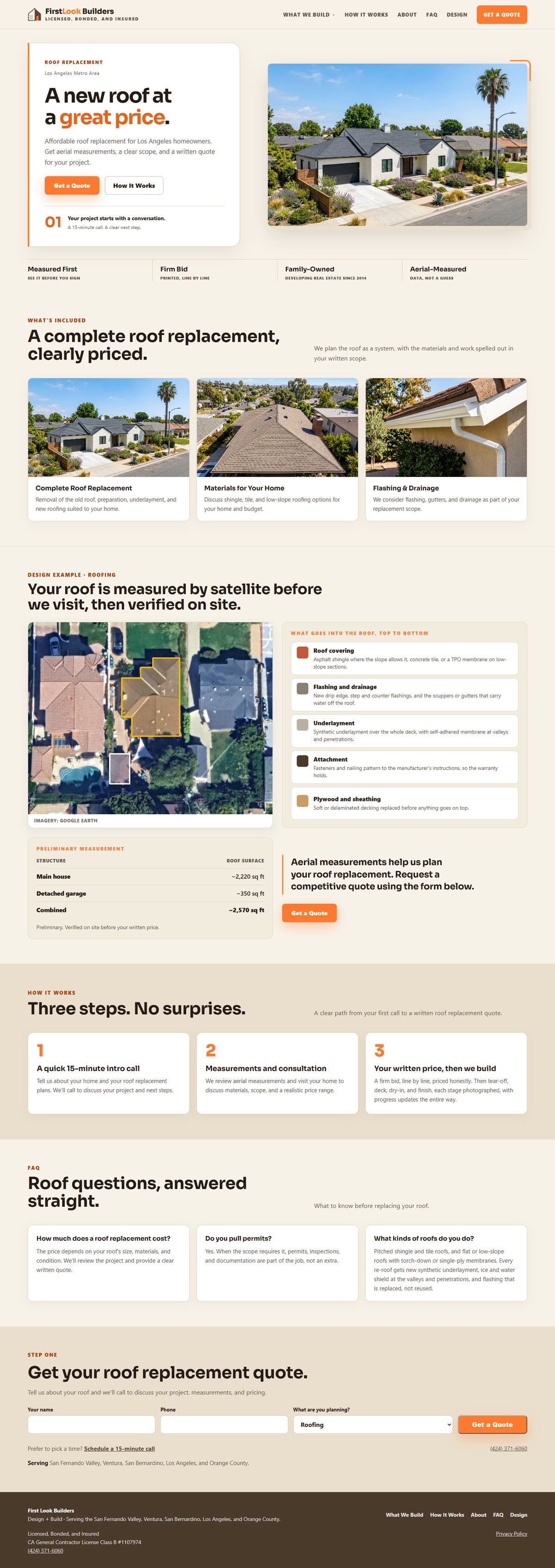
Aerial measurements, a clear scope and a written quote. The page outlines each structure on an aerial image and shows the roof area it gives.
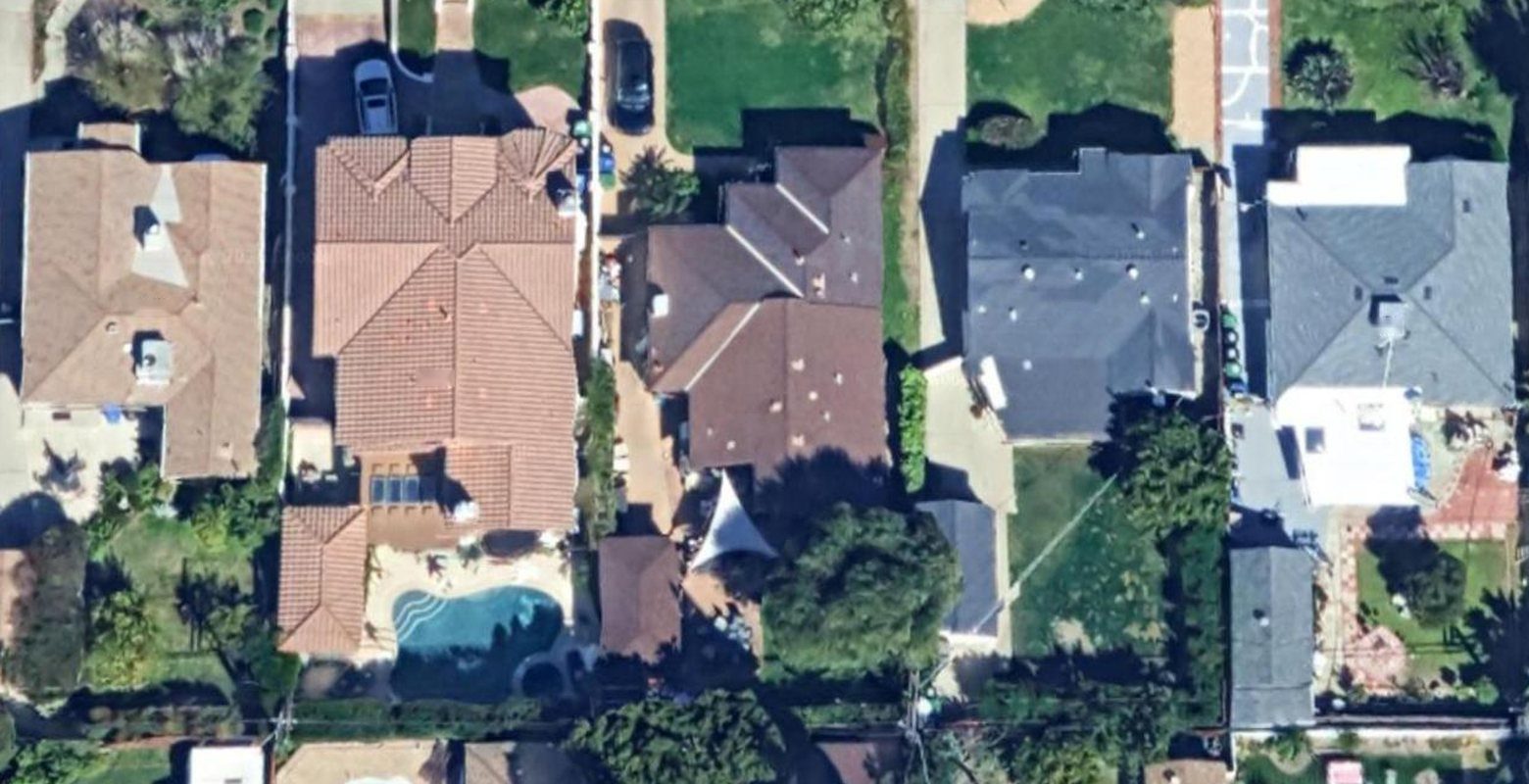 Imagery: Google Earth
This is a medium-slope roof. A sloped roof is larger than the flat outline under it, so the outline is multiplied by a standard allowance for the slope.
| Slope | Added to the outline | Multiply by |
|---|---|---|
| Medium | about 30% | 1.30 |
| Steep | a third or more | 1.33 and up |
| Structure | Flat outline | Slope | Roof surface |
|---|---|---|---|
| Main house | 1,708 sq ft | × 1.30 | ~2,220 sq ft |
| Garage | 269 sq ft | × 1.30 | ~350 sq ft |
| Combined | 1,977 sq ft | × 1.30 | ~2,570 sq ft |
Preliminary. The exact slope and the outline are measured on site before a written price is given.
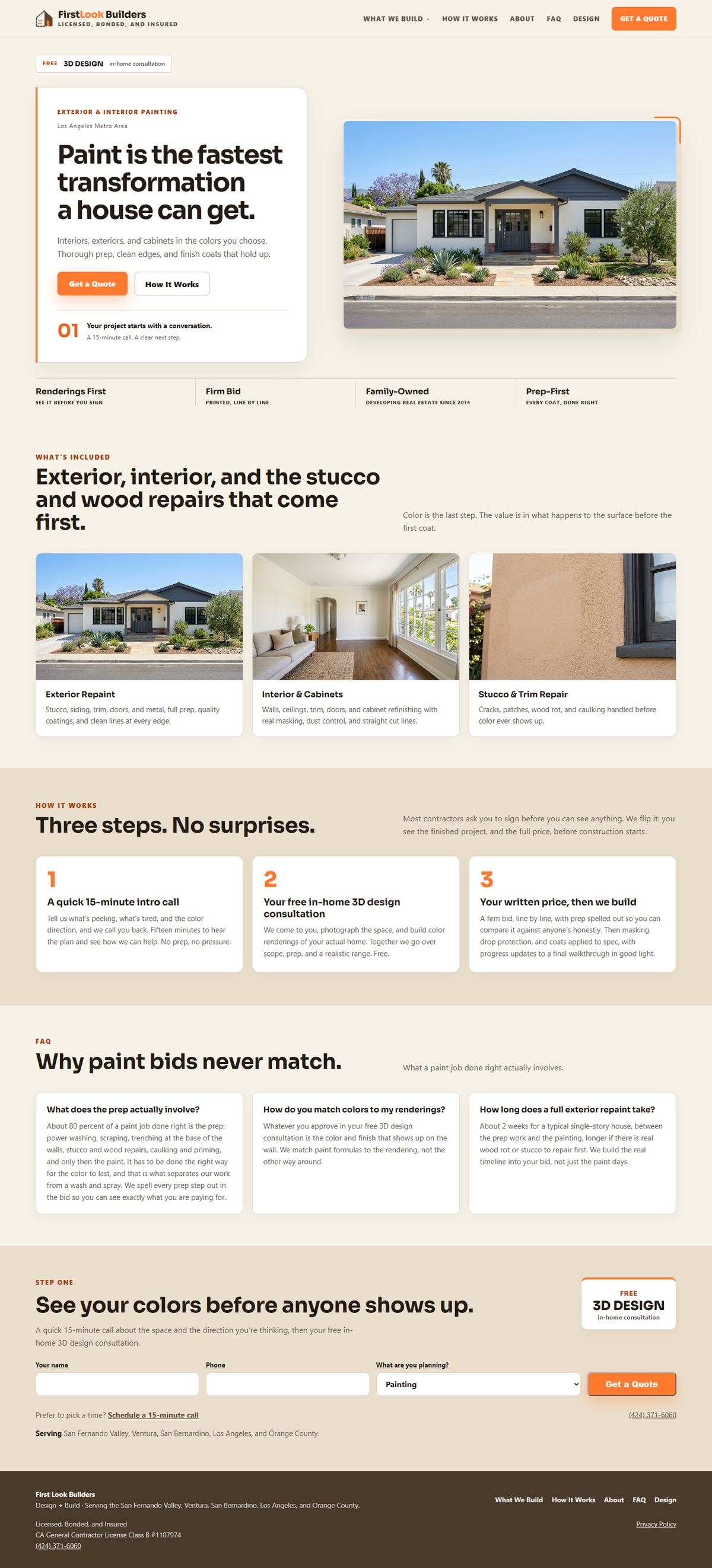
Interiors, exteriors and cabinets, with the prep and finish work spelled out.
The design service on its own page: proposed finishes, 2D and 3D views and a material list with a first budget. The 3D kitchen on this page is live here: use the button below to jump to it, then drag to turn it. It also starts on its own after a moment.
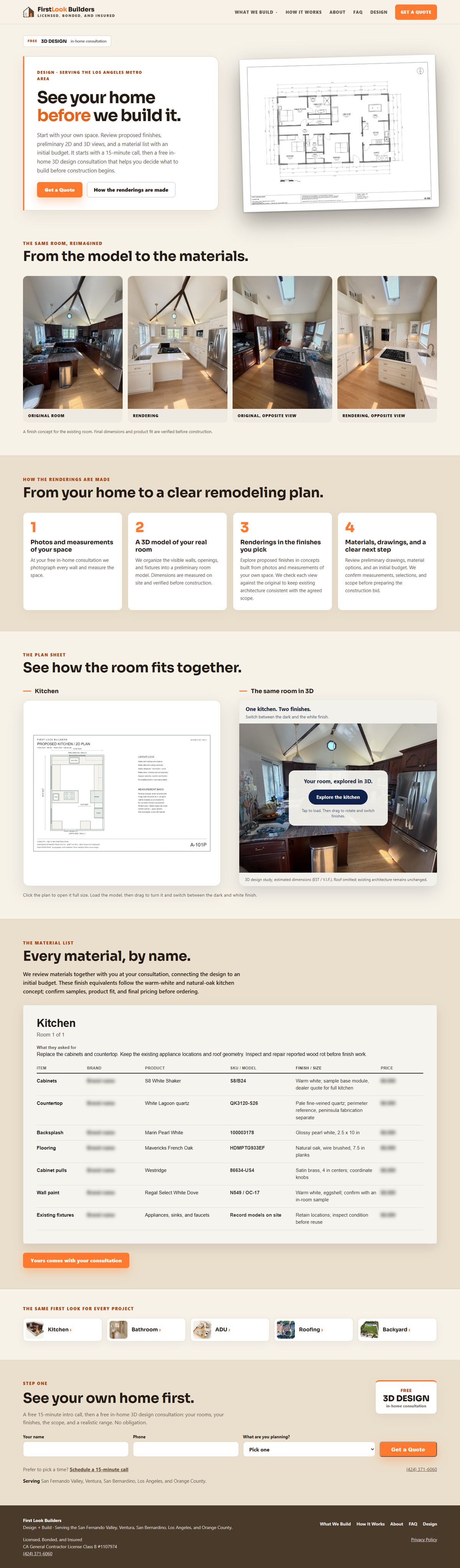
Page images are captures of the site as built.
Three things I do on every project.
A number without a source is a claim. The workbench is built so a reader can click any figure and land on the page it came from, and so the build refuses to publish anything it cannot trace. The same instinct runs the reconciliations: return versus bank versus books, before any multiple is discussed.
I am curious by nature and I like to research. I keep adding skills across real estate, finance, analytics and software, and I do the reading and lay out a roadmap before I bring AI into a project, so the tools are pointed at a plan and not the other way around.
I direct builds with AI models doing the typing: one writes, one reviews adversarially, one fixes, and nothing is called done until it runs and the output is in front of me. Agent runs in production propose changes as data and never write until reviewed. Token spend is tracked like any other cost.
The short version, with the full PDF beside it.
Aggregated and reported financial metrics and performance KPIs across private equity, real estate, credit and infrastructure strategies. Resolved limited partners' data pain points by establishing clearer benchmarking, investigating variances and quality-checking fund data captures. Managed relationships with two clients, a family office and a venture capital firm, with nearly $10B in AUM between them, and supported their software needs.
Cleaned and aggregated 350,000 rows of purchase data in Python for K-means clustering, time-series product pairings and an anomaly-detection rule; delivered scalable models and a Power BI dashboard to senior stakeholders.
Sourced deals daily across four listing sites and broker calls against the investor's buy box. Built the five-year acquisition model (DSCR, cash-on-cash, NWC, NPV, ROE), vetted three M&A lawyers for a deal under LOI and assembled the SBA loan package.
Offering memorandums and broker opinions of value for seven buildings; a ten-year ground-up apartment pro forma for lenders; a search of five national banks' office loan books for troubled West Coast loans nearing maturity.
Customer-acquisition and lifetime-value model comparing one-off and subscription pricing; market research on product fit in Midwest municipalities.
Maintained the capital-provider database, matched incoming deals to best-fit lenders and wrote a research piece on the student-housing sector.
Analytics Challenge, first place: NLP sentiment analysis over 30,000 reviews, presented in Tableau; invited to the 2025 INFORMS Analytics Conference. Real Estate Club 2021 to 2025.
Language: Hebrew (intermediate). Off the desk: tennis, hiking, music, walking the dog.
Email is best: orinozar2@gmail.com. Or find me on LinkedIn.